
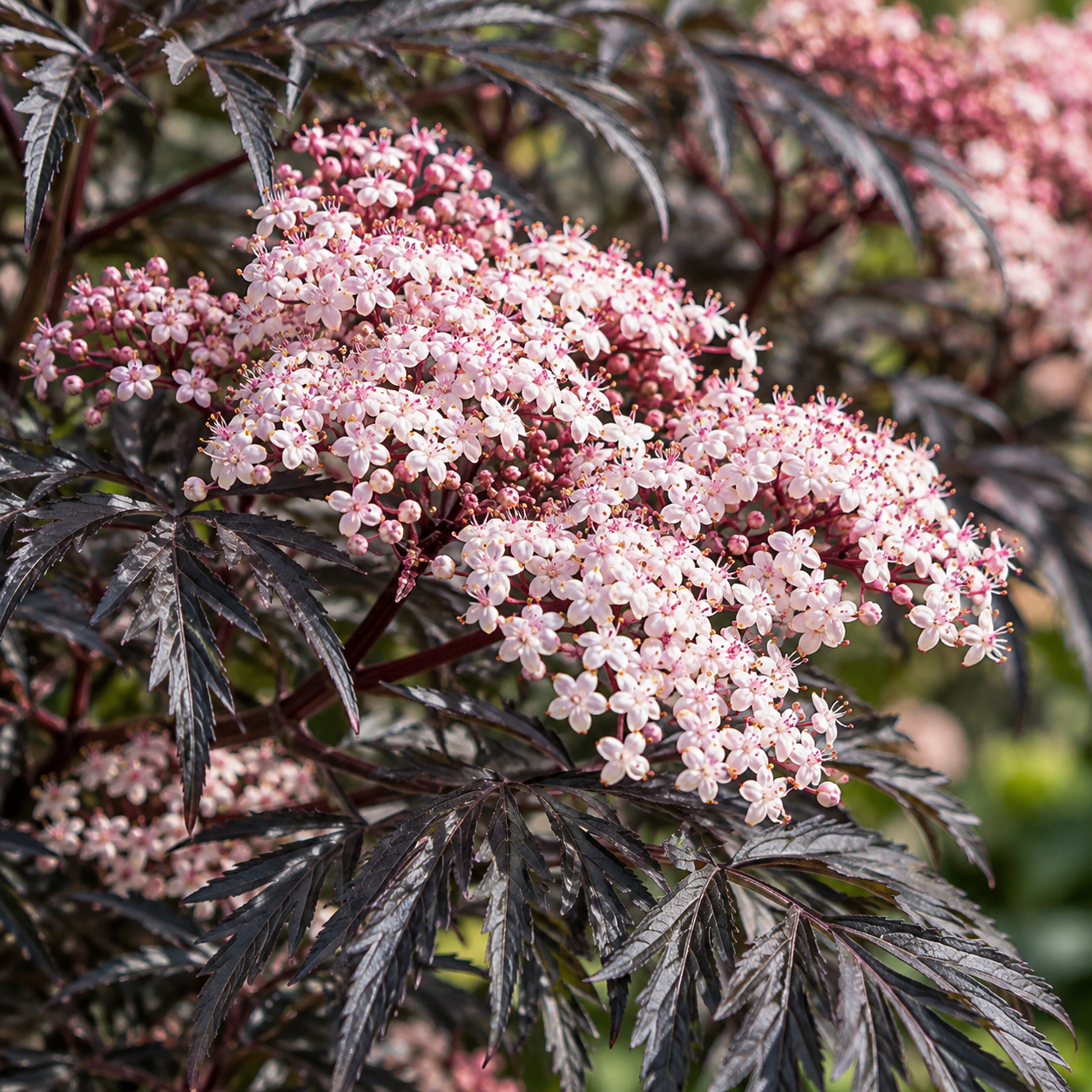

Sambucus nigra ‘Black Frills’ is a striking ornamental elder, grown for its finely divided, almost black foliage and beautiful clusters of delicate pink flowers. Its deeply dissected leaves create a wonderfully feathery appearance, providing dramatic contrast against the soft pink blooms that appear in late spring and early summer.
Growing into a hardy deciduous shrub, this unusual selection makes a stunning addition to mixed borders, wildlife gardens and informal hedging. The fragrant flowers can also be harvested to make homemade elderflower cordial, potentially giving it a delicate blush-pink tint. Its dark foliage provides architectural interest throughout the growing season, looking particularly beautiful alongside pale flowers and fresh green foliage.
Please note: These seeds have been collected from selected dark-leaved forms of Sambucus nigra. Seedlings may vary in foliage colour and flower shade, and some initially green-leaved plants may develop darker foliage as they mature.
When to Sow: Feb–Apr or Sep–Oct
HOW TO SOW: Sow seeds into trays or pots of moist, well-drained seed compost with added horticultural sand or grit. Cover to approximately the depth of the seed with fine compost, sand or grit. Place in a cool, sheltered outdoor position or cold frame, keeping the compost consistently moist but not waterlogged.
Avoid artificial heat. Seeds generally germinate in spring following exposure to cold winter temperatures, and germination can be slow and irregular. Some seeds may remain dormant until a second spring, so retain trays for at least two growing seasons. Once seedlings are large enough to handle, transplant into individual pots and grow on before planting into their final positions
- Classification: Hardy deciduous shrub or small tree
- Expert Level: Requires Experience
- Germination Time: Variable
- Flowering Time: May–Jun
- Site: Full sun to partial shade
- Soil Type: Most fertile, well-drained soils, including loam and clay
- Soil Acidity: Acid to alkaline
- Moisture: Moist but well-drained; tolerates a range of conditions once established
- Care: Water young plants during dry periods and mulch annually with organic matter. Prune in late winter or early spring to maintain the desired size and shape. Established plants tolerate hard pruning
- Use: Wildlife gardens, informal hedging, woodland edges, naturalistic planting, elderflower cordial and cooked elderberry preparations
- Harvesting: Harvest flowerheads in May–Jun when fully open and fragrant, ideally on a dry day. Harvest ripe, purple-black berries in Aug–Sep. Elderberries must be properly cooked before consumption; avoid unripe berries, leaves and stems
- Days to Maturity: Approximately 2–4 years to first flowering from seed, depending on growing conditions
- Vase Life: Approximately 2–4 days; delicate flowers are best used fresh
- Height: 3–6m or more if unpruned; can be maintained at 1.8–3m with regular pruning
- Plant Spacing: 2–3m for individual shrubs; approximately 1–1.5m for informal hedging